

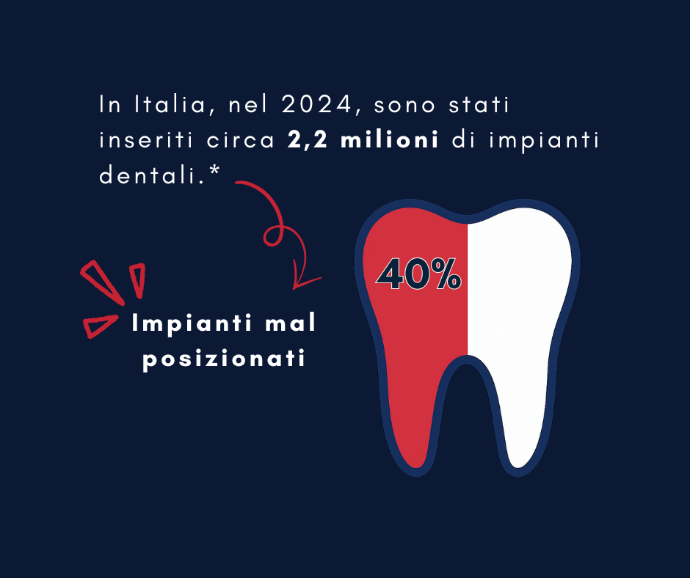
As highlighted by a recent survey conducted by the Key-Stone research institute's dental sector observatory, in 2024, approximately 2.2 million dental implants were inserted in Italy (an increase of 20% compared to 2019); it is estimated that up to 40% of these are poorly positioned. This data calls for in-depth reflection on the role played by surgical planning, the competence of the operator and, last but not least, the use of advanced technologies.
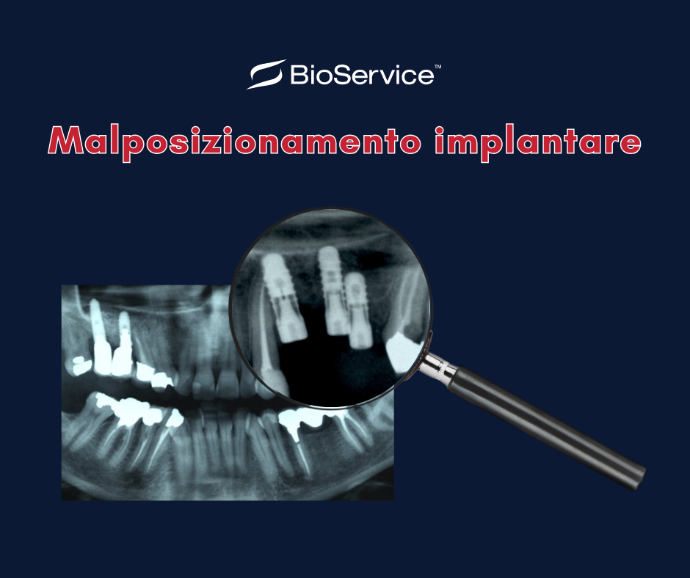
The consequences for patients are manifold: first and foremost, function, which consequently also determines aesthetics. An incorrectly placed implant can cause excessive exposure of the gums, making the smile look uneven and causing other pathological complications, first and foremost the risk of peri-implantitis.
So what are the main causes of implant malpositioning and how can this problem be avoided? Let's find out together in this in-depth analysis by BioService®.
Summary
The main causes of implant malposition
1. Inadequate surgical treatment planning
One of the most frequent causes is the lack of a thorough diagnosis and adequate prosthetic and surgical planning. The absence of upstream prosthetic planning can lead to implant placement that does not conform to the occlusal axis or the patient's aesthetic requirements.
2. Incorrect surgical techniques
During the surgical phase, errors such as excessive implant inclination or placement too close to sensitive anatomical structures can compromise the final result, leading to post-operative complications.
3. Professional inexperience
The training and experience of the practitioner play a central role. An international retrospective study co-ordinated by the Harvard School of Dental Medicine showed that the rate of implant failures is significantly higher among general practitioners than among specialists with advanced training in implantology.
4. Anatomy of the patient
Individual anatomical variables, such as gingival profile and the quality and quantity of available bone can influence correct implant placement.
5. Absence of surgical guides
The use of customised surgical guides s still too often underestimated. These tools, derived from digital surgical planning, allow accurate control of implant position, inclination and depth in prosthetic prosthetic function.
One of the most frequent causes is the lack of a thorough diagnosis and adequate prosthetic and surgical planning. The absence of upstream prosthetic planning can lead to implant placement that does not conform to the occlusal axis or the patient's aesthetic requirements.
2. Incorrect surgical techniques
During the surgical phase, errors such as excessive implant inclination or placement too close to sensitive anatomical structures can compromise the final result, leading to post-operative complications.
3. Professional inexperience
The training and experience of the practitioner play a central role. An international retrospective study co-ordinated by the Harvard School of Dental Medicine showed that the rate of implant failures is significantly higher among general practitioners than among specialists with advanced training in implantology.
4. Anatomy of the patient
Individual anatomical variables, such as gingival profile and the quality and quantity of available bone can influence correct implant placement.
5. Absence of surgical guides
The use of customised surgical guides s still too often underestimated. These tools, derived from digital surgical planning, allow accurate control of implant position, inclination and depth in prosthetic prosthetic function.
What are the solutions for predictable implantology?
- Careful planning
- Use of customised surgical guide
- Continuous training and professional education
- Multidisciplinary approach
Conclusion
Malpositioning of dental implants is not only an aesthetic problem, but a potential source of biological and functional complications. Preventing these errors is possible through accurate three-dimensional design, the use of digital surgical instruments and an interdisciplinary approach.
BioService supports dental professionals with high-precision implant components, up-to-date technical documentation and continuous training for modern and safe implantology that makes the dentist's job easier.
Follow us so as not to miss upcoming courses and insights!
BioService supports dental professionals with high-precision implant components, up-to-date technical documentation and continuous training for modern and safe implantology that makes the dentist's job easier.
Follow us so as not to miss upcoming courses and insights!